

The war of small things:
Iryna Shev on the normalisation of terror in Ukraine
Interview with Kyiv-based journalist Iryna Shev
By Maria Luísa Moreira
November 2025
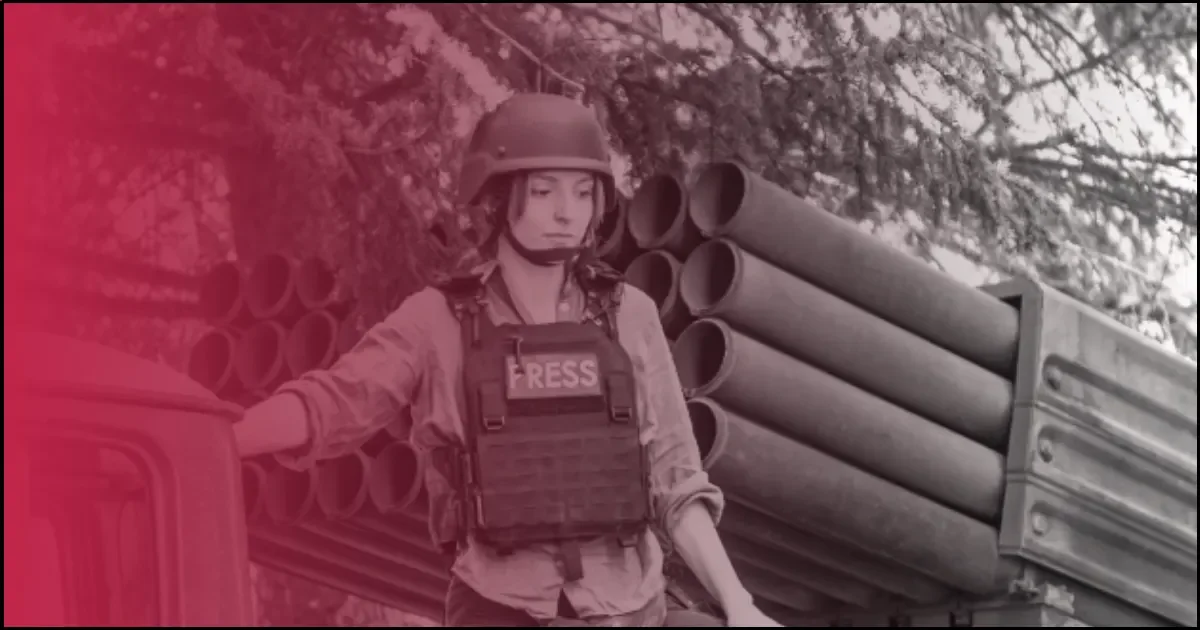
The war in Ukraine is often assessed in terms of territory lost or gained, but it is the human stories and everyday moments that best portray the true cost of the conflict.
Iryna Shev is a journalist who occupies a rare liminal space. Born in Ukraine but raised in Portugal, she has spent nearly a decade covering political issues in the safety of western Europe. In February 2022, as Russian troops amassed on the border, Shev made the choice of trading peace for war. She has since lived the reality she reports on, acting as a bridge between the public and the daily horror of the frontlines.
We sat down with her to discuss the war of small things in Ukraine, from identity to the normalisation of terror. Shev talks about the generational fractures within civil society, the reality of life under occupation and why everyday details, like the sound of an alarm clock, generate more empathy than headlines ever could.
I. The journalist-mediator
For the past three years, you’ve undergone profound changes personally and professionally. What called you to leave a peaceful country and return to Ukraine during conflict?
I moved to Ukraine permanently in the summer of 2023, but my relationship with this war began much earlier. In early 2022, when Russian troops were massing on the border and the Kremlin still called it “military exercises,” I pushed my newsroom to send a team. Portugal was in the middle of legislative elections, so I was told: first the election, then maybe Ukraine.
That “maybe” became real in February 2022, when I arrived in Ukraine with my colleague and friend Rui do Ó, a veteran war reporter who had covered Syria and Iraq. I had never worked in a conflict zone, so I knew I needed someone like him to show me what it actually means to be a journalist in a country at war.
At the time, most people here still didn’t believe in a large‑scale invasion. They expected more fighting in Donbas, not missiles falling on Kyiv. Then the 24th of February came and we were supposed to fly back the next day. Instead, the first bombs fell, our flight was canceled and suddenly we were among the very few foreign correspondents already on the ground as a war of this magnitude began.
Those first days were chaotic. We didn’t yet know where the most dangerous areas were or what basic routines could keep us alive. We had to learn quickly because if you don’t take your own safety seriously, you can’t do your job. For a while I shuttled between Ukraine and Portugal to rest, then returned again and again. At some point that wasn’t enough.
Like many journalists, I chose this profession because I wanted to tell stories. I realised that if I wanted to really mediate between Ukrainians and my Portuguese audience, I had to live here, not just parachute in. That’s when I made the decision to stay, even knowing it would change my life completely.
You describe yourself as both Ukrainian and Portuguese. How does that dual identity shape the way you see your role as a mediator in this war?
I often say I immigrated to the country where I was born. I left Ukraine as a child and grew up in Portugal. Part of my identity was formed there: my education, my language, my sense of humour, my understanding of what Portuguese people worry about and what they want to know. At the same time, I belong here in Ukraine. I speak the language, I know the history, and I grew up hearing my parents’ and grandparents’ stories about life in the Soviet Union and in the wild 1990s that followed its collapse.
Because of that, I don’t feel “more” Ukrainian or “more” Portuguese. Both identities are constantly present. When I choose which five minutes of an interview make it into a television piece, that choice reflects my personal angle. I’m thinking about the people who will watch in Portugal: What do they need to hear to understand what’s happening here? But I’m also thinking about the people I’ve just met in Ukraine: What part of their experience must not be lost? That’s what being a mediator means to me.
My life here is the life of an immigrant starting from scratch, with no network, building everything step by step, just like many Portuguese who move abroad. That shared experience helps me bridge the distance between these two societies.
II. The war of small things
In your work you insist that the truth of the war is in the details of daily life and routine. What do those look like in people’s lives?
When you live in a country at war, you start noticing how much history lives inside different generations. My grandmother’s generation, people now in their seventies, eighties, nineties, are children of WWII. They heard and lived through terrible things. They know exactly what invasion means, what it is to have armed men in your home, and the difference between a dictatorship and a free country. They are fearful, but they also feel they have nothing left to lose, so they speak more openly.
Then there is the generation that formed its identity in what many remember as the “golden age” of the Soviet Union. There were jobs, housing and education, even though there was no freedom. Many of them were completely shocked by this war. They grew up in an environment where “we are all brothers” was the official narrative, and painful stories about persecution, torture or deportations to Siberia were often hidden from children. Below them is the internet generation, so people who travel, see how Europeans live and want that same autonomy and dignity. They want their children to grow up with choices, not under a dictatorial state.
All of this is exemplified by an Ukrainian family I interviewed, a mother and her 16‑year‑old girl and her 6‑year‑old brother who spent years under occupation. The girl refused to attend school for the first year because the curriculum was rewritten to teach Russian history and the Russian version of events. She stayed in her room with a Ukrainian flag pinned to the wall and books she hid in case someone searched the apartment. She rehearsed escape plans in her head for what to do if armed men came through the door.
Later, when authorities began systematically checking which households had school‑age children, she was forced to attend a Russian school. Classes were heavily militarised and focused on indoctrination. She didn’t want to write in Russian and spent her lessons secretly listening to Ukrainian music. She knew that being discovered could mean being taken from her parents and sent to an institution. In the end, her mother decided they had to flee before her resistance cost them everything.
At the same time, the 6‑year‑old boy lived in almost total ignorance. To protect him, his mother and sister told him positive stories about Russia. Children have no filters; one careless sentence at school can put a family in danger. It’s the same survival strategy many families used in Soviet times: you don’t tell your children the whole truth so they don’t accidentally repeat it.
When the family finally escaped (a journey that can’t be described here because people are still being helped out of those territories) the boy almost exposed them. His sister had taught him a short poem in Ukrainian and as they crossed Russian territory surrounded by Russian citizens, he suddenly started shouting it. Nothing happened, but for the mother it was a moment of pure panic. It’s just a detail but you can really see fear, resistance and old traumas through it. That’s why the small things matter.
You also talk about “normalisation” and becoming numb to the reality of everyday terror. How does this change the way people live and how you tell stories?
At the beginning, every siren meant you ran. You went to the shelter, you counted the explosions, you wrote down where things hit. That level of vigilance is impossible to sustain every day for years. Over time, people start negotiating with risk. There’s a grim hierarchy now: if it’s ballistic missiles, you go to the shelter; if it’s drones, many people don’t move. It’s not that drones aren’t dangerous, but that people are exhausted.
I’ll confess that I turned off the air‑raid alarms on my phone at night because otherwise I couldn’t sleep. Rationally, I know I shouldn’t do that. But journalism doesn’t rest; the war doesn’t stop; and at some point your body and mind look for ways to function. That’s what “normalisation” looks like: living next to something that should never feel normal.
In my podcast, “Manual de Sobrevivência”, I tried to capture those first impressions before normalisation fully set in. One episode is about a night when my flatmate and I spent hours in a shelter during a bombardment. When it ended and we went back upstairs, we opened the door and her alarm clock went off. She laughed and said, “Thank you, but I’m already awake.” It was such a small, absurdly ordinary moment.
Later a podcast listener in Portugal wrote to me to say her alarm uses the same ringtone. Now every morning when it rings, she thinks of Ukrainians who might have spent the night in shelters 4,000 kilometres away. That’s the power of small details. They turn a distant, abstract war back into the daily life of people who are just like you.
III. The global cost of apathy
Three years into the full-scale invasion, many in the West feel overwhelmed by multiple wars. How do you think about global fatigue?
It’s natural for people to grow tired of watching war. The images are hard to process and we are living through many crises at once: Ukraine, the Middle East, Sudan and others that are overlooked completely. Sometimes it is simply easier to switch off the TV or scroll past. That doesn’t mean people are cruel or indifferent; it’s often a psychological defence mechanism.
For me, the question is: how do I tell a story that doesn’t make someone look away? The big political headlines , what Putin or Zelensky or Trump said, mostly come from agencies. My job is to show how those decisions land in people’s lives. That’s why I focus on details: the alarm clock, the price of bread, the way a teenager hides her books. When someone in Lisbon realises there is someone just like them in Kherson who wants the same things they do in life (like safety for their children, access to education, a decent job) something shifts. The distance shrinks.
Ukrainians felt the same before this war. When they looked at Syria, many felt sympathy but also distance; they had their own problems, their own bills, their own children to raise. But wars are always interconnected. In Syria, Russian forces tested tactics they now use in Ukraine. What happens “far away” doesn’t stay far away for long.
Looking beyond Ukraine’s borders, what do you think the end of this war will mean for the world?
However this war ends will set a precedent. Imagine a scenario in which Ukraine is forced to give up territory and is denied the right to choose its alliances. That would mean losing the ability to decide its own future. When a person loses subjectivity, we call it slavery. When a country loses it, we talk about spheres of influence, but the effect is similar: dependence, stagnation, vulnerability.
If there is no real accountability for what has happened in Ukraine (cities wiped out, people tortured and raped, children losing limbs or parents or both) then the message to other dictators is clear: this level of brutality is survivable, politically, and armies and countries can get away with it. It becomes a reference point for what is “tolerable.” Ukrainians feel this very strongly when they see talk of “normalising” relations with Moscow or proposals that imply Ukraine should concede territory. It feels like a second violence layered on top of the first.
So yes, this is Ukraine’s war, but it is not only Ukraine’s story. It is a test of whether borders, sovereignty and human lives still have any real meaning in the international system. If the answer is “not really,” that will be felt in many other places, far beyond this front line.
Iryna Shev is the Ukraine correspondent for SIC and Expresso.
You can follow Iryna’s work on Instagram.