
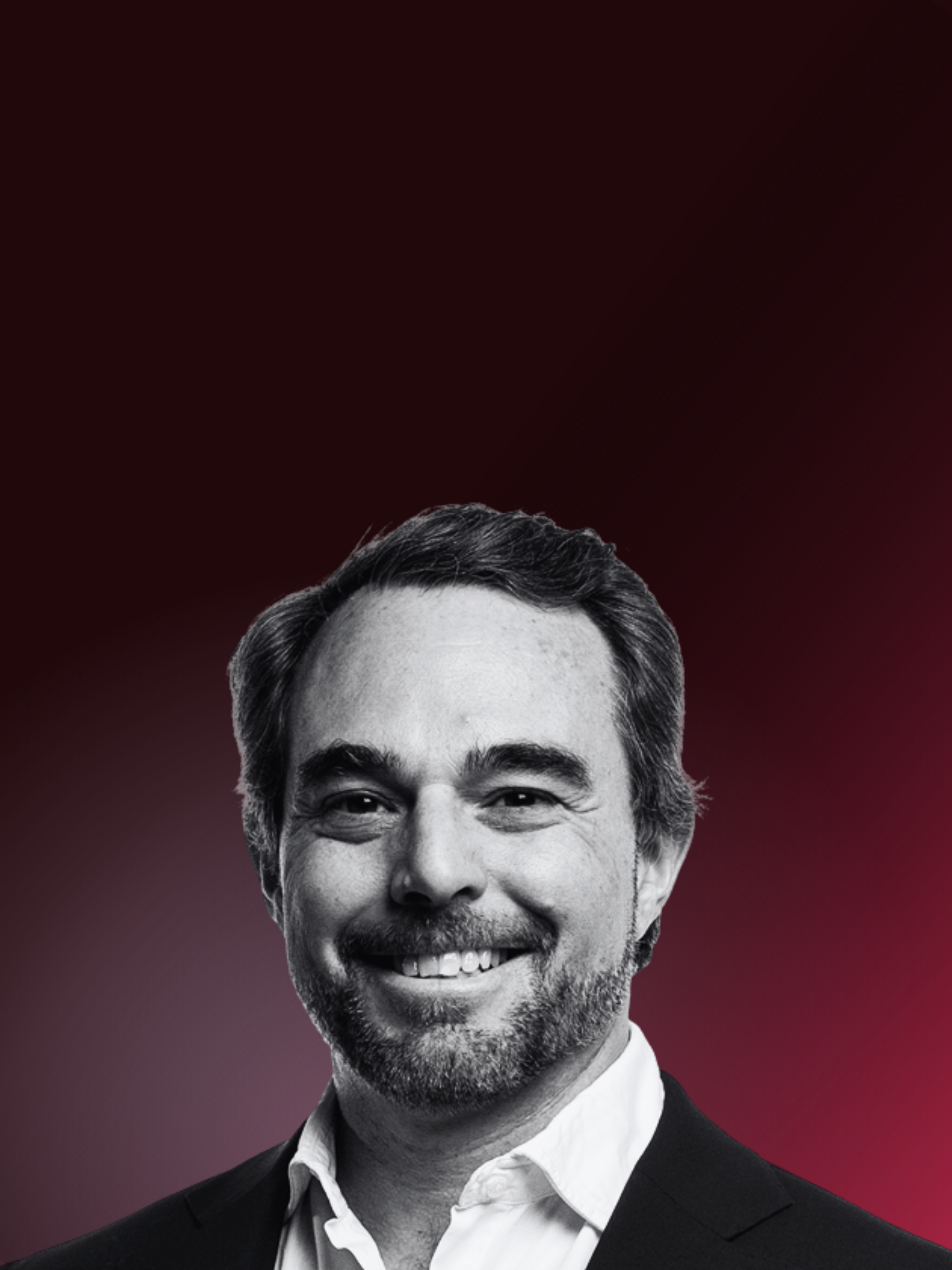
Is strategic foresight the EU's missing superpower?
Global affairs expert Ricardo Borges de Castro was part of the team at the EPC that first conceptualised this decade’s permacrisis, the term for the compound, communicating crises that now define European governance.
This conversation asks what strategic foresight actually demands of the EU and why its policymakers and institutions keep falling short in this era.
Global affairs analyst Ricardo Borges de Castro was among the team at the EPC that conceptualised the "permacrisis" we live in. The term, originally met with pushback from Brussels policymakers, now describes the default operating environment of European governance.
Borges de Castro has spent years arguing that strategic foresight is not optional for democracies under pressure. Recorded against a backdrop of institutional reform debates, shifting transatlantic relations and a world where predictability is no longer on the table, this conversation is about what foresight actually demands from people and institutions alike, why the EU still struggles to embed it, and what a proper long-term thinking infrastructure could look like.
The following interview was originally conducted by Maria Luísa Moreira as a podcast episode of The Diplomat's Cabinet in July 2025. It has been edited for length and clarity. Listen to the full conversation here.
The label and the thing itself
The conversation begins with a tweet. Shortly before we spoke, Vishwanath had posted three words in response to a social media prompt asking for a sad story: feminist foreign policy. The reaction was larger than she expected.
"I think it's because we are seeing, on the one hand, a backlash against FFP in so many parts of the world," she says. Ambika had just returned from Europe, Germany specifically, where a new government had taken office with inclusion removed from its stated agenda. She is careful to add a distinction that will recur throughout our conversation: "It is a question of language change, not necessarily priority change."
The FFP framework began in Sweden in 2014, moved through several European countries, then to Canada and Mexico. Its architecture, what Vishwanath refers to as "the three Rs and then the Ds" (i.e., pillars pertaining to representation, rights, resources and later to data, decoloniality and development) that structured its implementation, was shaped in those specific political environments. Vishwanath has spoken with people working on it across Europe, North America, Latin America, and parts of Asia, and she argues that “if you look at how it has been implemented in some of these countries, it has a very European transatlantic design around it." The assumption that the framework as designed would translate globally was, she suggests, the source of much of its failure.
The question she presses is whether that design must be universal. "Do we have to have only one framework? I don't think we can. The beauty of what could be a truly inclusive FFP is the multifaceted nature of it, and I feel like that has not really been explored."
Inclusion is not one size
What does a 21st century inclusive foreign policy actually look like? Vishwanath is honest about the limits of any single answer, and she points instead to a principle: inclusion must be defined in relation to what a country needs, and that varies considerably.
In India, inclusion encompasses gender, but also region, caste, ethnicity, and language. "For an incredibly diverse country, ensuring inclusion from all of these dimensions is very important. That might not be what is required of a country that doesn't have this level of diversity. For that country, inclusion might be more women than anything else." In other contexts, indigenous and tribal voices are the central concern. In others still, the urban-rural divide shapes what meaningful representation requires.
Forcing a single framework across these different realities, she argues, produces exactly the fragility now visible in Europe. "If you don't create a proper system, you don't have a framework, then you're going to see what has happened in Sweden and what is now happening in Germany: the minute you have a government change, you revert back. Probably to a system that is even worse than it was before." The problem with importing a framework is that it can be returned just as easily. Something built from within, through genuine trial and error, is harder to dismantle.
What India is actually doing
India has no FFP framework in place, but it does have a growing whole-of-government approach organised around the concept of women-led development, and a set of programmes, in trade, foreign assistance, education, and energy, that embed gender considerations without naming them as such.
Vishwanath does not claim India has all the answers. "If anyone were to tell you that India has figured it out, I would very much disagree with that", but she points to a pattern of concrete movement. Budget allocations for gender-related programmes across ministries are also growing, she notes, albeit from a low base. "There is a recognition that you cannot just say women-led development without putting money behind it."
The most significant recent example is the India-UK Free Trade Agreement, signed in May 2025, which includes a chapter dedicated to gender equality and the support of women entrepreneurs and women-led small and medium enterprises. "This is very new. This is not something we normally do." She reads it as evidence of shared recognition on both sides that supporting women’s empowerment has implications for national growth and for global development goals, and that recognition is now legible in a binding trade document.
India's foreign assistance programmes tell a similar story. Solar energy initiatives, education programmes in parts of Africa, a climate and disaster risk financing programme in Fiji that explicitly targets women: these have been studied by Kubernein Initiative across several years. "A lot of this has been a little bit ad hoc. But because we now have a whole-of-government women-led approach, there is a movement to try to consolidate, understand, and then create a framework that makes sense for a country like India."
The broader lesson she draws from the Indian case has implications beyond India. "It has to be something we have attempted, we have failed at, we have tried and tried and tried again, and then we have created something that is homegrown, which will then be more lasting. You cannot say: here is a framework, now you fit all your programmes into it."
A framework that outlasts its architects
The closing question is what she would say to the diplomats and politicians listening: what would actually change the trajectory of FFP?
Her answer is structural, and deliberately long-term. "Recognise that today, in 2025, the world doesn't look like how it was designed sixty or seventy years ago. It has fundamentally changed. To think of FFP or any global governance policy that is still one-sided, it's never going to last beyond a certain number of years."
She is clear that she does not consider the underlying concepts wrong, but denounces failures in implementation: too geographically bounded, too inattentive to the partners on the receiving end of foreign policy. "Your foreign policy ultimately is a foreign policy, not a domestic policy. So you have to consider your partners where you're implementing it around the world. Otherwise you're going to fall back into the same trap of thinking that what you have designed will work for everyone else."
Earned through trial, error, and genuine attention to context, the aspiration is a robust FFP framework that lasts beyond those who built it. One that, by virtue of being locally owned, stands a chance of surviving the next election.
Ricardo Borges de Castro is a global affairs analyst, author and lecturer. He was Associate Director at the EPC and served as foresight lead at the EPSC, the European Commission’s think tank under President Jean-Claude Juncker, and as Member of Cabinet of José Manuel Barroso, President of the European Commission. He holds a DPhil from the University of Oxford and a Master's from The Fletcher School at Tufts University.